AI in 2026 is not erupting in headlines; it is quietly restructuring enterprises. What began as experimentation with models and copilots has matured into full-scale operational transformation. AI is now embedding itself into core systems, decision frameworks, cybersecurity layers, and workflows.
At SBase Technologies, working across global IT environments, we see a consistent pattern: organizations that treat AI as infrastructure are accelerating. Those treating it as a tool are falling behind.
The following trends are not forecasts. They reflect what is actively unfolding across enterprise ecosystems in early 2026 and where strategic attention is moving next.
Top 10 AI Trends Reshaping Enterprises in 2026
1. AI That Thinks and Acts on Its Own
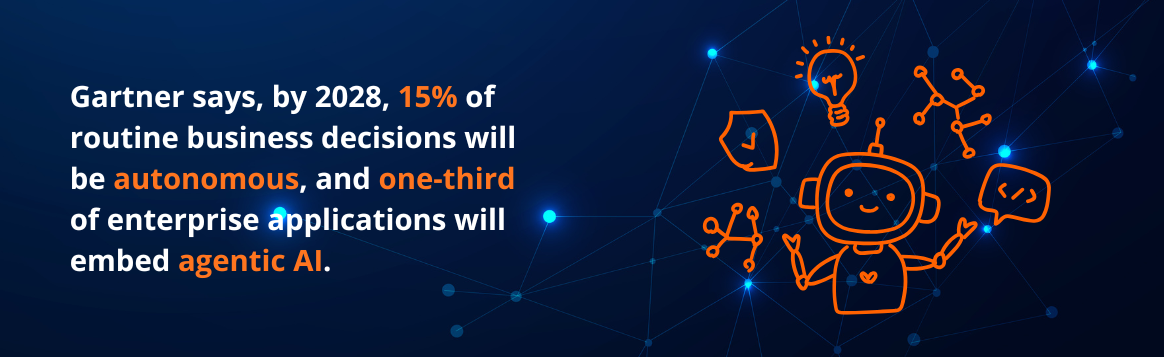
AI is rapidly evolving from an assistant into an autonomous operator. Agentic AI systems can now plan tasks, coordinate tools, and execute multi-step workflows with minimal human input. According to Gartner, by 2028, 15% of routine business decisions could be made autonomously, and one-third of enterprise applications will include agentic AI.
The future implication is significant: AI will not just answer questions; it will manage processes. Organizations are now investing in oversight layers, escalation frameworks, and real-time monitoring to ensure these systems remain controlled, secure, and aligned with business goals.
2. AI Is the New Operating Layer

AI is no longer a feature; it is becoming a structural layer of enterprise architecture. McKinsey & Company’s 2025 Global Survey found 88% of organizations use AI regularly, but only a small portion have scaled it across core operations.
The next phase is integration. Leading enterprises are embedding AI directly into ERP systems, analytics platforms, and operational workflows. In the coming years, AI will function much like cloud infrastructure. It remains invisible but essential, powering forecasting, automation, compliance, and strategy behind the scenes.
3. The Race for AI Supercomputing Power

AI at enterprise scale requires serious computing power. Governments and hyperscalers (large cloud service providers) are investing billions into AI supercomputing capacity. For example, Amazon announced plans for a $50 billion expansion in AI and high-performance computing capacity, according to Reuters.
Why it matters: Large models require massive GPU clusters, but enterprises also need this power for real-time fraud detection, supply chain simulations, and risk modeling. In the future, compute capacity will directly influence innovation speed, making AI infrastructure a strategic differentiator, not just an IT upgrade. (Reuters)
4. Smarter Infrastructure, Not Just Bigger Servers
Scaling AI is now about optimizing how and where it runs. Deloitte states that while token processing costs have dropped due to hardware advances, overall, AI spending continues rising because of increased usage and complexity.
Enterprises are adopting hybrid architectures that combine cloud, private environments, and edge computing. This allows AI models to run closer to where data is generated, reducing latency and improving performance. The future of AI infrastructure is distributed, efficient, and workload-aware, not centralized and oversized.
5. AI vs AI: Cybersecurity and Threat Defense
AI is transforming cybersecurity from reactive monitoring to autonomous defense. Global cybersecurity spending is projected to surpass $240 billion in 2026, with AI-driven detection and response leading investments. Modern AI systems analyze billions of events in real time, identifying anomalies, zero-day threats, and behavioral risks faster than human teams.
As generative AI empowers attackers, enterprises are deploying AI-powered SOCs and automated response systems. The future of security is adaptive, self-learning, and operating at machine speed.
6. From Software Tools to AI That Delivers Outcomes
Traditional software delivers features. AI is beginning to deliver outcomes. Gartner describes a shift toward “Outcome as Agentic Solution” (OaAS), where AI agents execute tasks across systems and deliver measurable business results.
Instead of logging into multiple tools, enterprises will rely on AI agents to complete workflows — such as processing claims, optimizing routes, or reconciling accounts. Early adopters in healthcare, logistics, and finance are seeing efficiency gains because AI coordinates systems in real time. The long-term shift is from software management to outcome management.
7. Data Quality Is the Real AI Advantage
High-quality data has become the foundational constraint for successful enterprise AI. AI systems depend on structured, governed, and accessible data for reliable decision intelligence.
Business leaders recognize that data architecture: metadata management, lineage, and governance, is critical to turning AI investments into scalable operations. Without discipline in data quality and readiness, model outputs erode trust and business value.
High-performing companies treat data as strategic infrastructure, not just an input, supporting robust AI pipelines that inform decisions in real time. (forbes.com)
8. AI & Workforce Transformation
AI is reshaping workforce structures and job roles. McKinsey’s research shows agentic AI adoption is prompting organizations to redesign workflows and rethink roles, with human employees increasingly focusing on orchestration, governance, and strategic interpretation rather than manual execution.
New roles such as AI orchestrators, governance architects, and multi-modal system integrators are emerging to bridge human judgment with automated systems. As firms scale AI, talent strategies now emphasize hybrid competencies blending technology, business strategy, and domain expertise.
9. AI-Powered Decision Intelligence
AI is fundamentally changing how decisions are made in enterprises. Research from Deloitte and McKinsey highlights that firms using AI for decision support combining predictive analytics with real-time operational data gain measurable advantages in agility and outcome quality.
Decision intelligence platforms embed machine learning and reasoning capabilities directly into business processes. This enables dynamic scenario analysis and proactive strategy adjustments. High performers report benefits not only in costs but also in innovation and revenue growth by aligning AI intelligence with strategic objectives.
10. Governance and Responsible AI Integration

Embedding governance and accountability into AI systems has become non-negotiable. Deloitte emphasizes that organizations need robust access controls, model isolation, and security strategies tailored to AI workloads to mitigate risk and establish trust.
This includes ethical guardrails, audit logging, and explainability frameworks that align AI behavior with regulatory and risk management standards.
Enterprises with mature governance frameworks are better positioned to scale AI with confidence and avoid costly compliance pitfalls.
Successful AI integration starts with structured, governed data. Learn how our DataGenAI solution helps organizations operationalize AI at scale.
AI 2026 Statistics
- By 2028, 60% of brands will leverage agentic AI to enable streamlined, one-to-one customer interactions. [Gartner Predicts]
- While 88% of organizations report regular AI usage, only a limited percentage have embedded it at scale within core operations. [McKinsey Report]
- Amazon announced a $50 billion investment to expand its AI and high-performance computing infrastructure. [Reuters Stats]
- Global cybersecurity spending is expected to exceed $240 billion in 2026, driven by AI-enabled defense and real-time response systems. [Gartner]
How AI Is Reshaping Key Industries in 2026
AI’s impact in 2026 is no longer conceptual. It is operational, embedded, and measurable across industries.

Financial Services
Banks and insurers are integrating AI into core risk and compliance systems. Real-time fraud detection engines now analyze high-volume transaction data streams in milliseconds, strengthening anti-money laundering controls and reducing false positives.
AI-driven credit risk models and regulatory reporting tools are improving accuracy while lowering operational overhead.
Healthcare
AI is being embedded across clinical and administrative workflows. From diagnostic imaging support to automated claims adjudication and capacity planning, AI is reducing cycle times and improving resource allocation.
Emerging agentic systems help in coordinating data across clinical, billing, and insurance platforms, improving system-wide efficiency.
Manufacturing & Supply Chain
AI-powered predictive maintenance models are minimizing unplanned downtime, while digital twins simulate operational scenarios to anticipate disruptions.
Advanced demand forecasting and inventory optimization models are improving supply chain resilience in increasingly volatile global markets.
Retail & E-commerce
AI is moving beyond recommendation engines. Enterprises are deploying real-time pricing optimization, demand sensing, and dynamic inventory allocation systems that respond instantly to consumer behavior shifts and supply constraints.
Public Sector
Governments are modernizing legacy systems with AI-enabled document processing, citizen service automation, and cybersecurity monitoring, while simultaneously building stronger governance and compliance frameworks to manage AI responsibly.
Across industries, AI is evolving from a productivity enhancer to an orchestration layer that coordinates systems, decisions, and workflows at scale.
Key Barriers to Scaling AI
Despite high adoption rates, many organizations struggle to scale AI effectively. The issue is rarely the model. It is the foundation.
1. Treating AI as a Tool, Not as Operating Model
Companies deploy AI pilots without redesigning workflows, governance, or architecture. The result is fragmented impact.
2. Ignoring Data Readiness
Poor data quality, siloed systems, and weak governance ruin model reliability and trust.
3. Scaling Too Fast Without Controls
Deploying AI without explainability, access control, and monitoring creates compliance and security risks.
4. Underestimating Workforce Transformation
AI adoption requires role redesign, not just training. Organizations that fail to redefine responsibilities create friction and resistance.
5. Focusing on Cost Savings Alone
The real value of AI lies in resilience, speed, and decision quality not just automation savings.
Enterprises that avoid these mistakes treat AI adoption as a structural transformation, not a technology upgrade.
What 2026 Demands
Enterprise AI in 2026 requires structural readiness, not incremental adoption. To operate effectively in this new environment, organizations must:
- Re-architect core systems so AI is embedded into workflows, ERP platforms, security operations, and decision processes. Not layered on top of them.
- Invest in scalable compute and hybrid infrastructure that can support real-time processing, simulation workloads, and distributed AI execution.
- Establish enforceable governance frameworks including model monitoring, auditability, access control, and risk oversight aligned with regulatory expectations.
- Strengthen data architecture through lineage tracking, metadata management, and quality controls to ensure decision integrity.
- Redesign workforce models to integrate AI oversight, orchestration, and cross-functional accountability.
- Align AI initiatives directly with measurable business outcomes, not isolated innovation metrics.
In 2026, performance gaps will increasingly reflect architectural maturity. Organizations that embed AI into their operating model will scale securely and adapt faster.
Leave a Reply